
For years, I asked myself whether hope or fear moved students to become better stewards of the environment. I leaned hard on hope, because I did not want seven-year-olds carrying these huge issues on their shoulders. I had watched that happen in well-meaning classrooms when students learned about deforestation in the Amazon. They came away feeling small and powerless.
Teaching sustainability to young students starts with building a relationship with one place and considering one eco-action they can take. A young child does not need the climate crisis explained. She needs a green space she has interacted with all year, and a small, doable eco-action that supports this place she has come to care about.
What does sustainability mean for students?
Sustainability means meeting our needs without negatively impacting the ability of others, human and otherwise, to meet theirs. Students who spend a year exploring their schoolyard already understand. They have seen renewal, seasons, and consequences of poor choices. They know that the place gives to us and that we can give something back. This is systems thinking at the elementary level.
Students come to care about the natural world by connecting to and knowing it. A class that planted a garden, or watched the same trees since September, will want to protect them without anyone asking. Show that same class a slideshow about deforestation, and what mostly hits them is the size of the problem (and their inability to do anything about it). When students come to know a place first, they start to care about it, and then they are motivated to find something they can do to give back.
What does one eco-action look like?
Eco-action is a way to protect and care for the environment that a student can start this week and see results soon. I check every activity I pick against this test: is it actionable, and will they see the impact?
When introducing eco-action to my students, I start with a book. Flight of the Hummingbird is a parable rooted in the Quechua people of South America, retold by Haida artist Michael Nicoll Yahgulanaas in his own style. A forest is burning. The big animals stand and watch it burn, while the hummingbird flies back and forth carrying water one beakful at a time, and when the others ask what she thinks she is doing, she says, “I am doing what I can.”
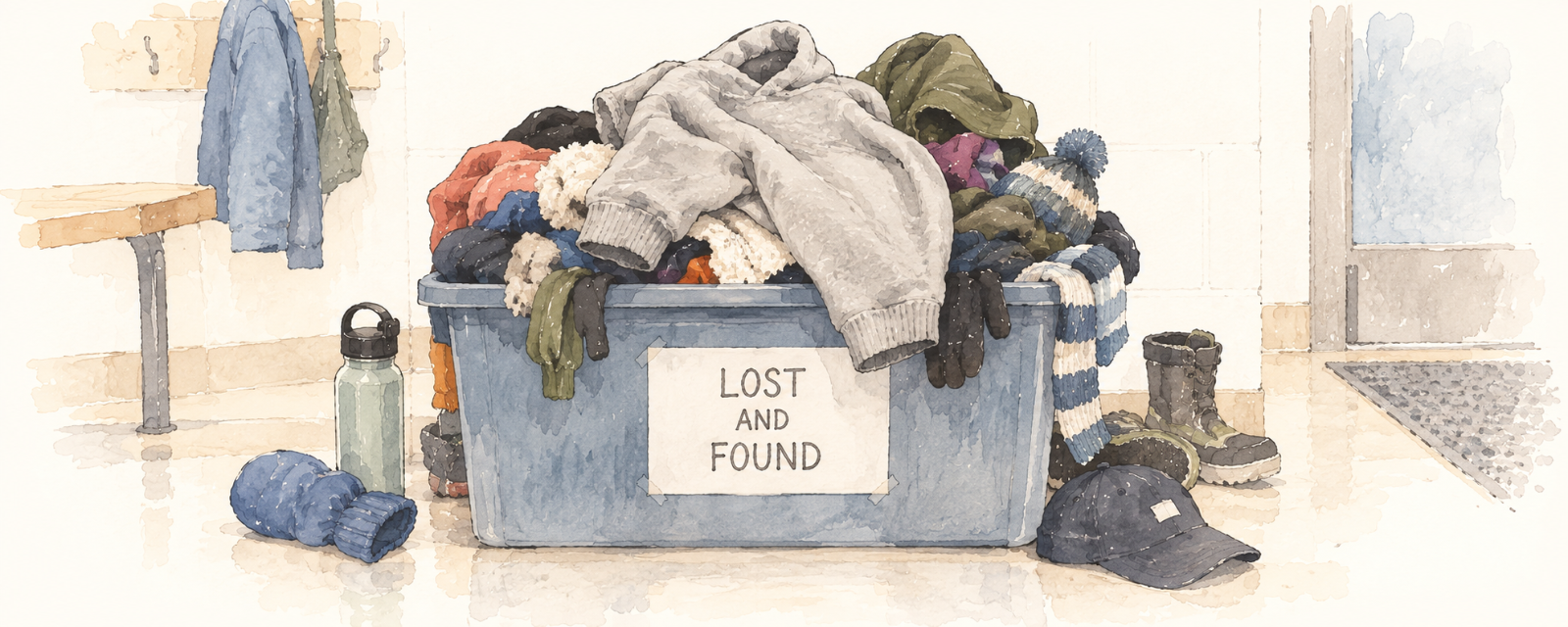
After reading the story, we do not make a list of what governments or big companies ought to do, because a letter to a minister can feel empty to a student who never sees a reply. Instead, each student names one thing they can do here at school, hummingbird-sized. Some pick pencil duty, some take on the compost bin, and my favourite is addressing the Lost and Found bin.
I like to walk students through the chain of events that can positively or negatively impact our environment. A lost hoodie goes in the Lost and Found bin. If it stays in the bin, it will get replaced. Parents will buy a student a replacement hoodie, and it may be a fast fashion item, cheap and quickly made. Every hoodie took real water, cotton, and work to produce. So retrieving one and getting it back to its owner cancels a second purchase that never needed to happen, and the result is one students can see for themselves: an emptier bin.
It always makes me think of my grandmother when she would say, “Waste not, want not.” We can reuse and recycle, but if we reduce our impact in the first place, the planet will be all the happier for it.
Field Note
The hoodie in the bin is made of oil
Most fleece is polyester, and polyester is plastic made from oil, which is not what students expect a hoodie to be. The average Canadian throws out about 37 kilograms of clothing and textiles in a year, and most of it could still have been worn by somebody.
Fleece sheds as well. Ocean Wise found that a typical household in Canada and the United States sends around 533 million tiny fibres into the wastewater system every year, just from doing the laundry. Getting one hoodie back to its owner means one fewer hoodie has to be made.
Sources: Recycling Council of Ontario · Ocean Wise
What does this look like on the schoolyard?
Each spring, when I taught grade two, we studied Properties of Liquids and Solids and Air and Water in the Environment. We had learning activities we could do inside, but the unpredictable spring temperatures meant we could investigate the traits and changes associated with liquid and solid states of matter and look at the water cycle, the properties of air and water, and the importance of resource conservation on the yard.
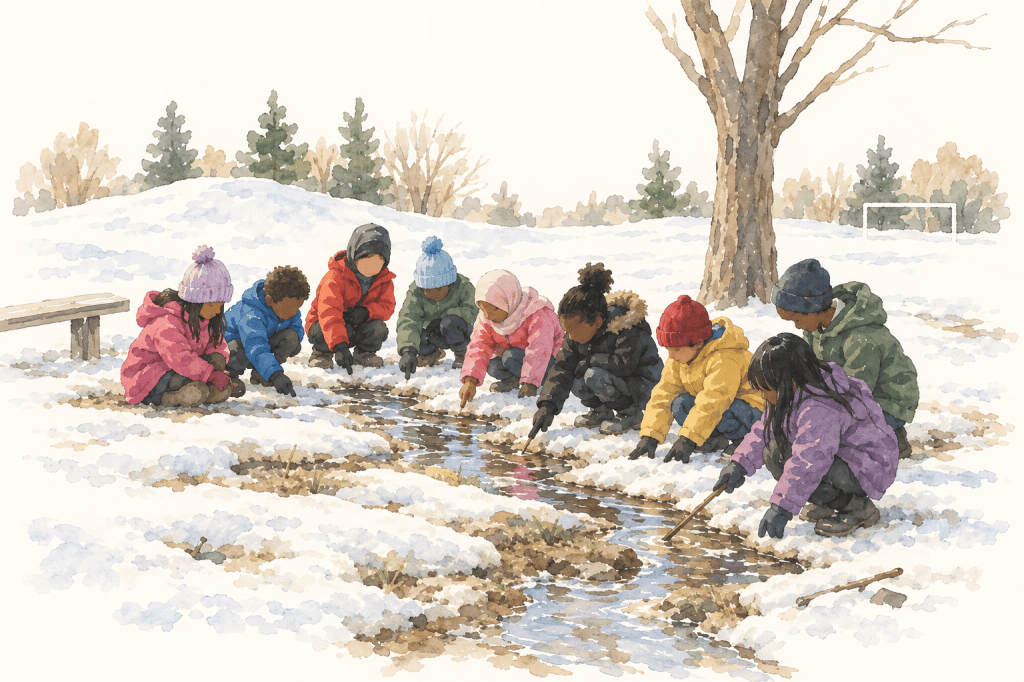
We observed solids turning into liquids and liquids turning back into solids. We drew chalk circles around the perimeter of puddles and measured them as they evaporated. And we tracked the giant snow hill melting. At the start of spring, students could walk up the packed snow to the top of the soccer crossbar. Week by week, students measured the melting snow; I photographed them against the crossbar, and we compared the photos as the hill sank. By the end, all that was left was a small pile of black snow: snow mixed with the grit spread on the pavement all winter, scooped up by the plows.
At the same time, the melting snow hill became a giant puddle that formed over the field drain. When the temperature warmed up and the snow melted quickly, the drain could not keep up. Each year, a small lake formed, and a family of ducks even stopped by. When the water eventually drained, students asked where it went. So we investigated further. The water from the snowpile would go down that drain, into the storm sewer, and out to the river, carrying all the debris with it.
As the water went down, we invariably found the winter’s litter caught at the drain. By then, the students knew this drain ran to the river where plants and animals live. They understood that this litter was on its way to the river. The eco-action came straight from the investigation: a yard cleanup to collect winter’s litter. Nobody had to convince the class it mattered.
Can you promise students their actions will fix climate change?
No, and you should not try. Students today know more than we ever did at their age, and the crisis is already at the door, in wildfire smoke on a June morning and extreme weather events like the Derecho. It swept the Windsor-to-Quebec City corridor in May 2022, and passed over roughly 15.6 million people, about 40 percent of Canada’s population, in a single afternoon. You cannot promise a child that sorting the recycling fixes the world, and they can smell a false promise from across the room.
My own thinking shifted here too. For a long time I offered only the hopeful side, and on its own that turned out to be too thin. Students feel the whole range, worry and anger and grief included, and we are not there to talk them out of any of it. We stay with them while they feel their emotions and help them stay steady, so they don’t shut down years from now when they are the ones at the decision-making table.
What is one thing to try this week?
After any outdoor session, ask one question at the gathering spot: what did this place give us today? Take every answer seriously, including the silly ones. Then ask what the class could give back, and pick the one thing you can actually do that week or that month.
The relationship underneath all of this starts with connection to nature.
If you are not sure where to start, read What Is a Listening Walk? or get the free Listening Walk lesson. For how this fits a normal schoolyard and timetable, start with Outdoor Learning on a Schoolyard: The Big Idea, and what you need to take a class out is in What Do You Need to Take a Class Outside?
Questions teachers ask about teaching sustainability
How young is too young for sustainability?
No age is too young for the relationship piece: noticing a place, caring for it, and giving something back. Hold back on the systems half, meaning supply chains and climate policy, until students can lead the questions themselves.
How do I teach this without causing eco-anxiety?
I try not to hand a student a responsibility they cannot carry. I am cautious even with well-meaning programs like litterless lunches or winter walk-to-school days because both ask students to change things they do not control. A student does not pick what goes into their lunch. Their family does. A student cannot choose to walk when the family lives too far away, or when the parent or caregiver who drives them cannot take time off work to walk them instead. So I keep eco-actions at school, where every student has the same chance to do them: anyone can check the Lost and Found.
Does teaching sustainability fit the curriculum?
Yes, sustainability is embedded in all subject areas rather than existing as a single standalone subject. Concepts like environmental stewardship, climate change, ecosystems, and conservation are woven directly into science, social studies, geography, and math (e.g., living things and habitats, weather and seasonal change, materials and conservation, and community responsibility).
What counts as a good class eco-action?
The test is whether a student can start and complete the eco-action themselves. Anything that requires a budget, an adult’s permission, or someone else to act first belongs in a later grade. Small is the right size to start. For examples of youth eco-actions, check out Our Canada Project.


Leave a Reply