
Sometime around the early 2010s, I noticed a shift with each new batch of students in my French Immersion classes. It seemed like suddenly, large numbers were reluctant to take risks, the kind you need to take to speak a new language. As a result, these students would rather stay silent than risk making a mistake. It went beyond having a “growth mindset”. And it was not just in French. They were cautious in their play. I was struck by one student who would not walk on the grass at recess. When I asked why, the answer was, “I don’t have anyone to play with.” They were cautious in their work, and cautious with their answers, wanting to find the “right” answer.
Something interesting was shifting in our society as the word “parenting” became a verb. Childhood was becoming more curated and planned; think multiple after-school activities coupled with playdates the parents arranged, leaving fewer chances to take risks and learn from mistakes.
I was seeing the impact in my French Immersion class. I asked students to take one of the biggest risks there is: speaking a language they were still building, when many of them had rarely been given the chance to take a risk of any kind, even in their play.
What does risk actually mean here?
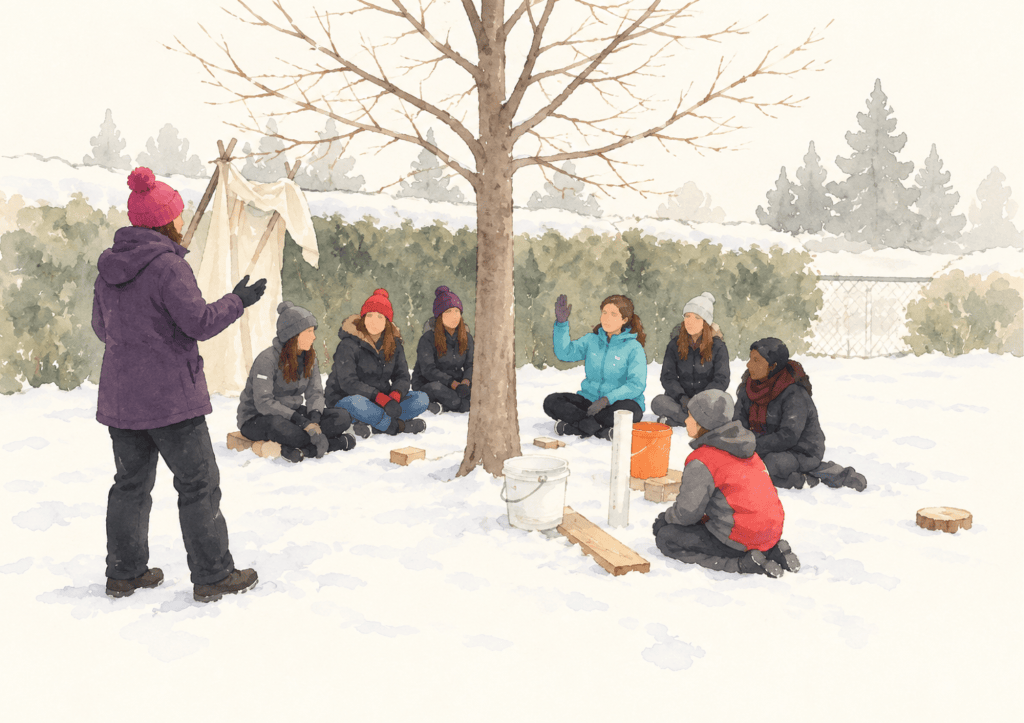
Taking risks should not be conflated with danger. For a six-year-old, a risk is jumping into a puddle, touching a worm, running down a slope, or answering a teacher’s question when they are not sure. The distinction matters because “risky play” alarms administrators and parents until they define it. Once it is, it stops being alarming and becomes what they remember from their own childhoods: play with some risks. In a school context, freely chosen play with risks is just that: free play.
I had been thinking about this shift in childhood. I had three young children at the time, and I was living the shift in real time. Even if I wanted my children to roam around our neighbourhood, there would not have been any children for them to play with. They were all at pre-arranged playdates, generally inside their homes. As early as 2007, resilience researchers like Michael Ungar at Dalhousie University, author of Too Safe for Their Own Good: How Risk and Responsibility Help Teens Thrive, were using the term “bubble-wrapped” kids in their work. Other terms like intensive parenting, concerted cultivation, helicopter parenting, and the one that has driven my work, nature-deficit disorder (Richard Louv’s Last Child in the Woods), point to the consequences of adults taking over childhood.
Why would experiences learning outdoors impact learning in French?
Research shows a student who practises taking small risks, and finds out they “survive” them, brings that willingness to take a leap back into the classroom. A systematic review led by Mariana Brussoni at the University of British Columbia, published in 2015, examined the relationship between risky outdoor play and children’s health across 21 studies. The study found that play environments where children could take risks promoted increased play time, social interaction, creativity, and resilience, and gave children the chance to learn their own limits. I watched it happen again and again. The students who rolled down the hill at the back of the yard or jumped off a boulder in September were also more likely to raise their hand to answer in November. An environment built for small risks lowers anxiety, and a new discovery gives students a topic worth learning new vocabulary and sentence structures for.
Peter MacIntyre at Cape Breton University has studied French Immersion students specifically and found them genuinely ambivalent: wanting to speak and holding back in the same breath. His research on willingness to communicate, the second language field’s term for whether a student will choose to speak when the chance comes, finds that the two most direct influences on a student’s willingness to speak a second language are anxiety and their own sense of competence. That willingness rises with familiar partners, familiar topics, and contexts that feel safe. Without knowing the term for any of it, I had been building all three conditions on our yard: my students spoke with partners they knew, about things they had found themselves, in a place they had visited so often it felt like theirs.
I wanted some data to back up my hunches. So, I developed pre- and post-assessments to track risk-taking of all kinds in my classes. I recorded my observations and could check what I thought I was seeing: outdoor learning having a positive impact on student achievement in French. Very quickly, going out onto the yard felt urgent. I stopped feeling like we were taking a nice wellness break and started feeling like it was learning itself.
How did my teaching practice change?
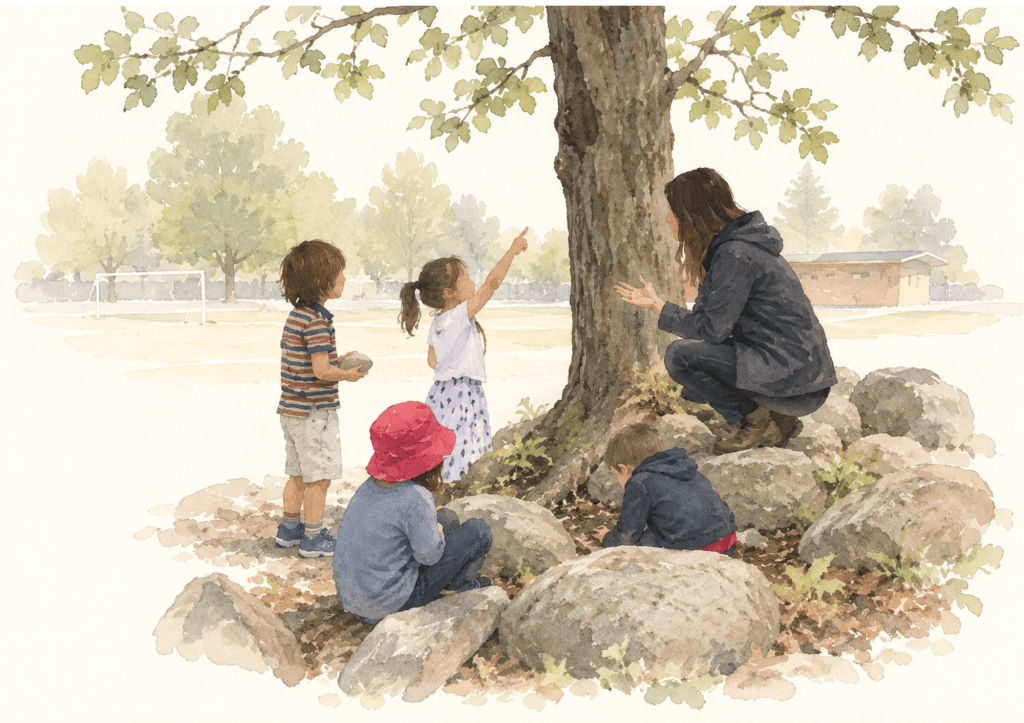
A chance meeting with a speaker at a board PD session, Marlene Power, who would become executive director of the Child and Nature Alliance of Canada, opened a door to something I had not even considered: becoming a Forest School practitioner. She pointed to research showing that each generation of children has been allowed to roam less than the one before, and she talked about what that shrinking range was doing to children’s mental health. Something clicked. The children she was describing were my students, and I remember thinking, “I need to know more about this.”
The language moves I use outside, including what I do when the discovery arrives in English, are in a post to come.
Field Note
The French word on every head in the yard
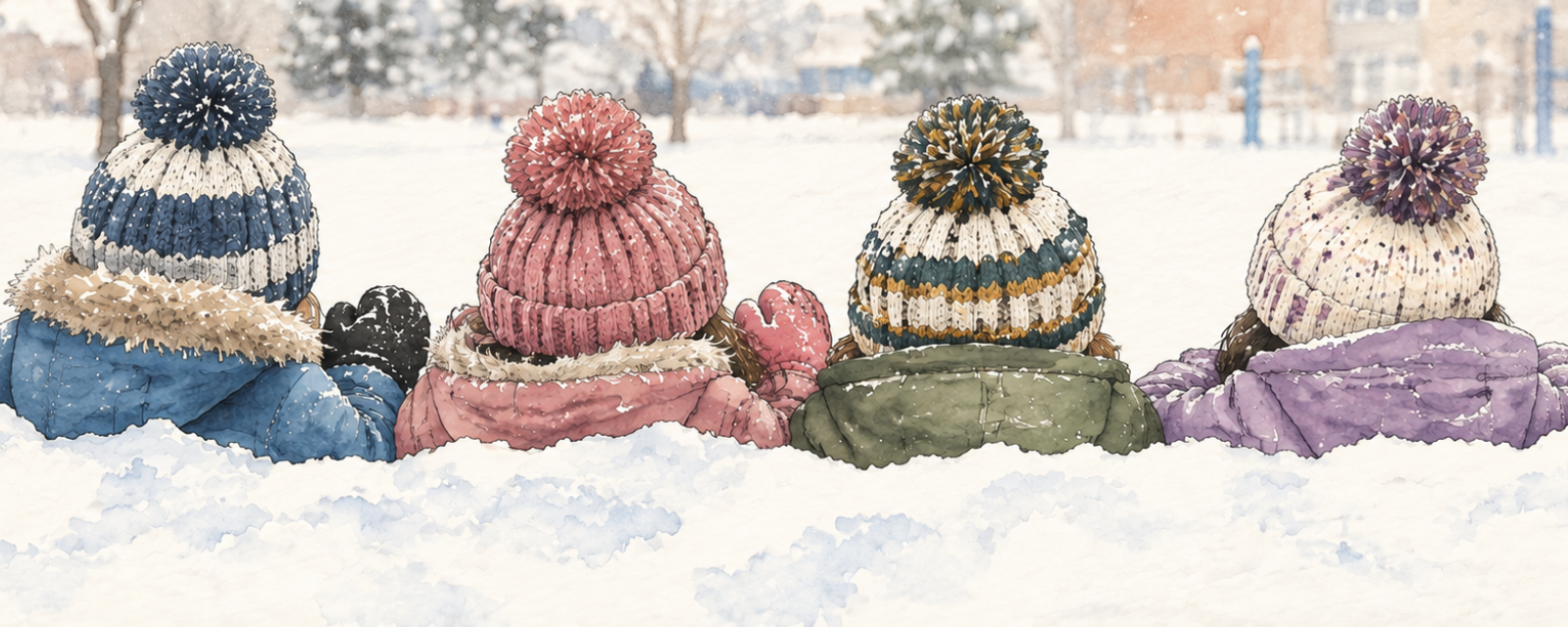
Look out at your class on a January morning and count the tuques. The word is Canadian French, borrowed into English so long ago and so completely that most English speakers have no idea they are saying a French word at all.
English speakers do not seem to agree on how to spell it: toque, tuque, or touque. The Dictionary of Canadianisms at UBC calls it one of the most widely known Canadianisms, worn and spoken in every province and territory.
Sources: Dictionary of Canadianisms on Historical Principles (UBC), “toque” · The Canadian Encyclopedia, “Tuque”
What changed for the students?
Early one September, in the meadow of the green space we visited frequently, a student called out, “Oiseau jaune!” We took out the bird identification guides I had downloaded. Birds Canada has an amazing tool on their site: it allows you to set the date, pinpoint your location, then view and print your photo bird ID guide. Together we identified the bird: un chardonneret jaune. An American goldfinch. Once she knew the name, there was no stopping her. She would drop it casually into conversation and share it during the knowledge-building circles we ran.
That meadow is the same forgotten patch of land my students later wrote letters to save, and the whole story of the place is in What Is Place-Based Learning?.
If you want a first outing that needs almost no vocabulary to begin, the free Listening Walk learning activity guide is complete, printable, and ready to go: get the free Listening Walk learning activity guide. The thinking behind it is in What Is a Listening Walk?.
Questions teachers ask
Is risky play allowed at school?
Each school and school board is different. Check your board policy, and speak with your principal and custodian. Create a plan that fits within the board’s guidelines. For more on this topic, see What Do You Need to Take a Class Outside?.
What if a student gets hurt?
I have observed fewer injuries when learning outdoors than in a typical gym class or recess period. I have sent my fair share of students to the office for ice after playing line tag or for bandaids from playing four square on the asphalt. In my experience, when students co-create outdoor learning guidelines, injuries go down.
How is this different from just letting them play?
It is play, and that is the point, because play is where my students practised taking risks. In a French Immersion classroom, it is the authentic situation that invites students to speak French. The difference is what I am doing while they play: watching, listening, and staying close enough to hand over the French word at the exact moment a student needs it.
Does the risk-taking really transfer to academics?
The research shows play builds exactly the traits a classroom runs on: resilience, creativity, and knowing your own limits. My own data, gathered over more than ten years, shows student achievement and well-being improved with regular, repeated outdoor learning sessions.
Where do I start?
Take one learning activity you were planning to do inside and do it outside: data management (counting leaves and sorting them into categories), procedural writing (describing the steps involved in using snowshoes), or mapping in social studies (a map of the built and natural features of the yard). Add more as you build your confidence and your students build their stamina.


Leave a comment