
Environmental inquiry is learning that starts with a student’s real question about the natural world. The teacher structures the investigation by observing, recording, researching, and returning to the question over time without giving students the answer.
In my first year teaching in a public school, I brought a found feather to my grade six class and placed it in a mystery bag, the way I often did with nature objects. It was a game I played to encourage students to practice posing questions. Once they guessed what the object was, the students had more questions. Whose was it? Where did it come from? Where was the bird now? My honest answer to most of their questions was “I don’t know, let’s find out.”
Meanwhile, in Science, we were working on the Biodiversity strand, so we launched a collaborative bird inquiry! I was pleasantly surprised by their enthusiasm and how so many had connections to birds. In subsequent years, birds kept coming up time and again as an inquiry topic with all kinds of elementary students.
Field Note
The blue jay is not actually blue
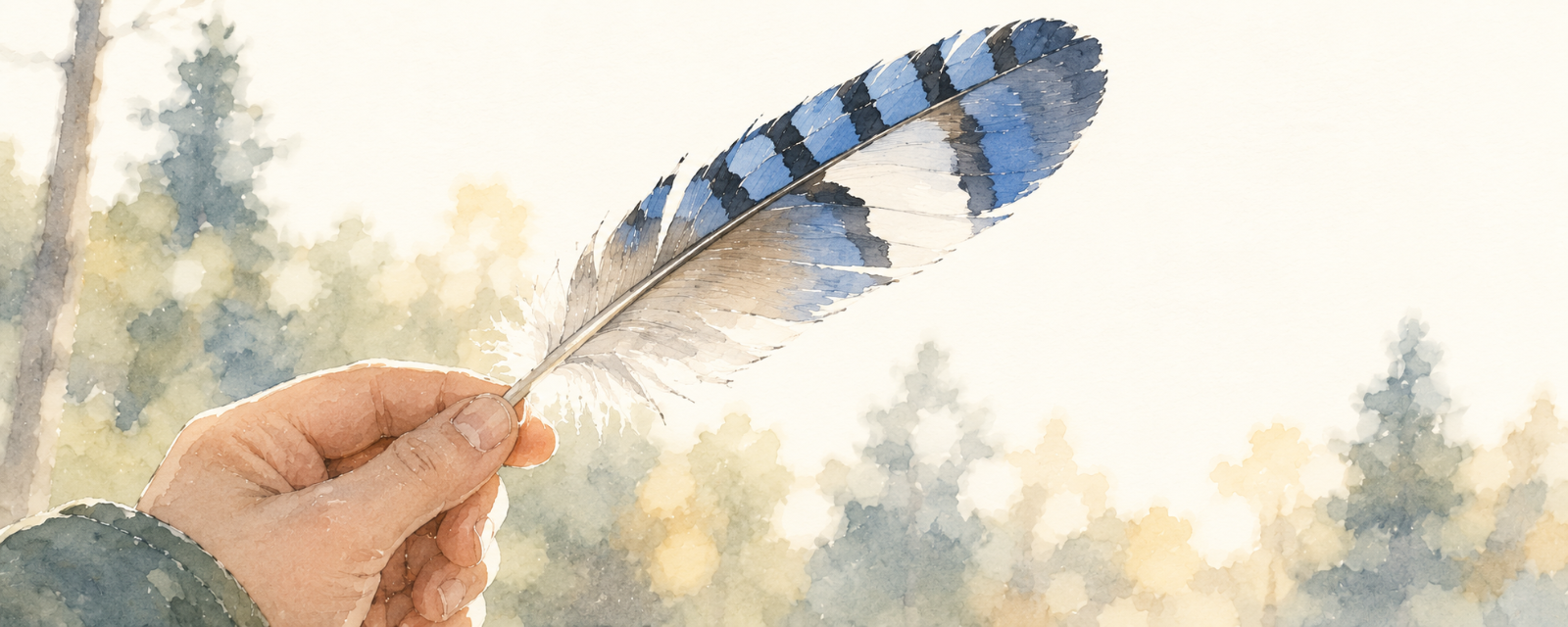
A blue jay feather has no blue in it at all. The only pigment it carries is melanin, the same brown in your hair, and the blue you see is a trick of structure: tiny pockets of air in the feather scatter light so mostly blue bounces back to your eye.
Hold the feather up with the light behind it, and it turns brown because you’re now looking straight at the pigment instead of the scattered light. No bird anywhere makes blue pigment, so every blue feather your students find works this same way.
Sources: Nature Canada, “Are They Actually Blue?” · Toronto and Region Conservation Authority
Where does environmental inquiry come from?
The framework I followed early on came from Natural Curiosity, an educator resource developed at the Dr. Eric Jackman Institute of Child Study, the laboratory school at OISE, University of Toronto. It is the book I hand to teachers who ask me where to start. The authors organize environmental inquiry into four branches:
- Inquiry and Engagement
- Experiential Learning
- Integrated Learning
- Moving Towards Sustainability
The original is available for free as a PDF. If you want to buy it, buy the second edition from 2017. The authors rewrote it to centre Indigenous perspectives in children’s environmental inquiry, pairing each branch with an Indigenous lens: Lighting the Fire, Sending Out Roots, The Flow of Knowledge, and Breathing With the World. Reading it changed how I hear my students’ questions.
Why do students ask more questions outside?
Students ask real questions outside at a rate and depth I don’t often see inside the classroom. Why is the frozen puddle yellow? Where do the seagulls go at night? What do you call a pinecone from a tamarack tree? Where do the squirrels go when it is snowing? How do migrating birds know which way is south?
Outside, there is always something new to notice, and less of the time is scripted. A student who finds something worth wondering about has the time to investigate and explore.
I wrote about working with the affordances on our typical schoolyard in Outdoor Learning on a Schoolyard: The Big Idea and about treating the neighbourhood as curriculum in What Is Place-Based Learning?
What does the teacher actually do during an inquiry?
Making the inquiry magic requires behind-the-scenes work before going outside: getting permission, selecting a learning goal, thinking about provocations, setting exploration expectations, assessing student learning, etc.
- Select a learning goal and choose which follow-up questions. Some will invite exploration; others may fizzle. It is all part of the process of knowing what your learners are curious about.
- Decide which resource to share with students next: a book, a field guide, a nature journal, etc.
- Name the curriculum out loud as it happens, so students know that counting squirrel dreys after the autumn leaves fall is data management and telling a story about what they observed is oral communication.
- Keep bringing students back toward your learning goal, because you still have one, and a report card due in November.
I assess while the inquiry is running, and I lay it out in Going Further: Teaching the Curriculum Outdoors. If you want more on holding students’ interests and a real curriculum at the same time, that is the whole subject of What Is Emergent Curriculum?.
What if students find open questions challenging?
Some students find open questions unsettling at first, and it is usually the ones who are best at regular school. They are used to knowing the right answer, and guessing in front of everyone feels to them like being wrong in public.
So I turn it into a game. In small groups, I ask students to write down 100 questions about the inquiry topic. It is an absurd number on purpose. Nobody reaches it. But partway through they stop worrying about which questions are good ones and just write, and a few of the questions they shake loose turn out to be great.
Does every question need to become an inquiry?
No, and most questions should not. Some are answered in an afternoon. What you are building is a class that asks questions on purpose, students who investigate instead of waiting to be told. Asking and checking is how they learn to think critically about everything else.
How do I start an environmental inquiry?
The next time a student asks you a real why question outside, and not a procedural one, try not answering it right away. Write it up where the class can see it, and tell them you will find out together.
A listening walk is the most reliable way I know to collect an initial set of questions. The free learning activity guide is here: get the free Listening Walk learning activity guide. I wrote about the routine itself in What Is a Listening Walk?
Questions teachers ask
Is environmental inquiry the same as inquiry-based learning?
Inquiry-based learning is a general method that can apply to any subject. Environmental inquiry is that method with the question aimed at the natural world, usually the part of it students can walk to.
How is environmental inquiry different from a unit?
When I plan a unit, I know the destination and plan backward from it. In an inquiry, nobody in the room knows the answer yet, including me, and the work is finding it out. The planning structure stays; the answer is genuinely open.
What if I don’t know the answers?
Then you are set up well. That is the normal condition for this work, and it models exactly the thinking you are trying to teach. Use your expertise to structure how students find out.
How do I assess inquiry learning?
I watch what students say, do, and produce as the work happens, and I follow my own method in Going Further: Teaching the Curriculum Outdoors.


Leave a comment