
Loose parts are materials with no fixed purpose: sticks, crates, planks, tree cookies, pipe lengths, tarps, buckets. Students move them, combine them, and turn them into whatever they are building. One student can use the same stick as a fishing rod and then use it as a post to hold up a tarp. By contrast, a moulded plastic slide on the play structure is not a loose part, because a student can only slide down it.
The first time someone watches a loose parts session, they usually ask what the students are supposed to be building. Often the answer is nothing in particular. The students imagine, build, take it apart, and start again.
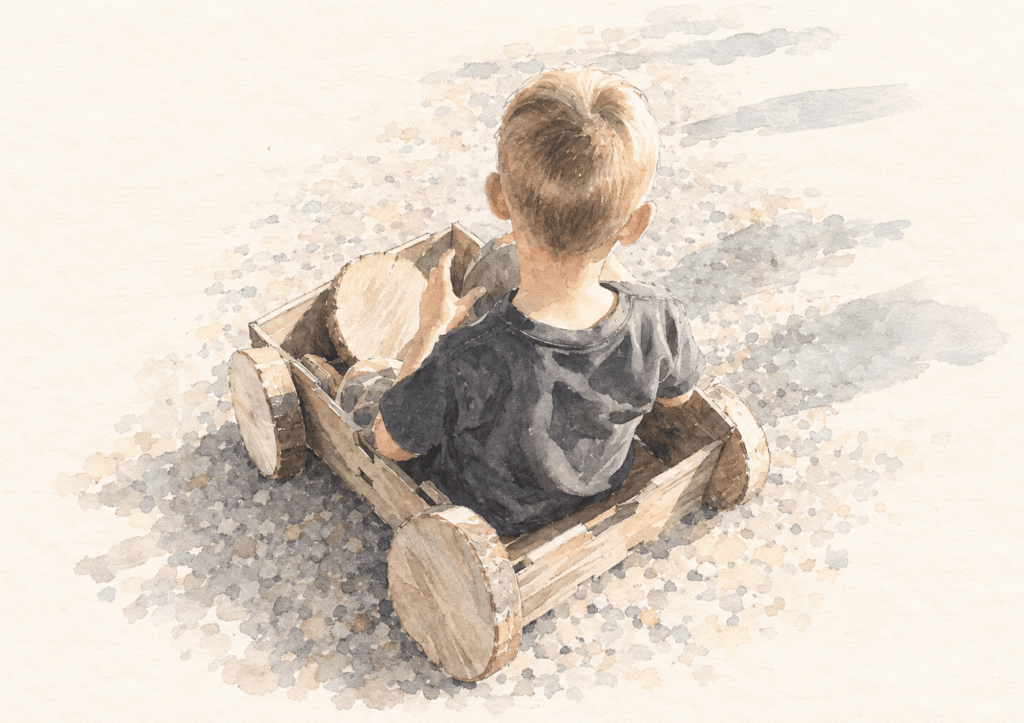
What does a loose parts session look like?
On a loose parts morning, the students help bring out the materials: cardboard, crates, planks, wooden spools, lengths of eavestrough and PVC pipe, tarps, buckets, and a stack of tree rounds we call cookies. The students sort most of it out themselves. Many already have an idea in mind and work with friends to make it happen. The adults step back. By the end of the block, there may be a ship, or a run of pipes along the fence carrying water from a bucket down to the “mud factory”.
Where does the idea of loose parts come from?
In 1971, an artist and design teacher named Simon Nicholson published a paper in Landscape Architecture with a title I have always loved: “How NOT to Cheat Children: The Theory of Loose Parts.” His theory is one sentence. “In any environment, both the degree of inventiveness and creativity, and the possibility of discovery, are directly proportional to the number and kind of variables in it.” Students invent more when they have more to move and change. Nicholson argued that when we bolt everything down, we cheat children by leaving them nothing to invent.
For a long time, the benefits of Loose Parts Play rested on a persuasive hunch. The research has since caught up. When studies added loose parts to ordinary schoolyards, children moved more, played more inventively, and cooperated more readily; the Sydney Playground Project ran the largest of these trials. Canadian researchers like Mariana Brussoni at UBC link this kind of free, outdoor play to real gains in children’s health, confidence, and independence.
Field Note
The beaver that builds by ear
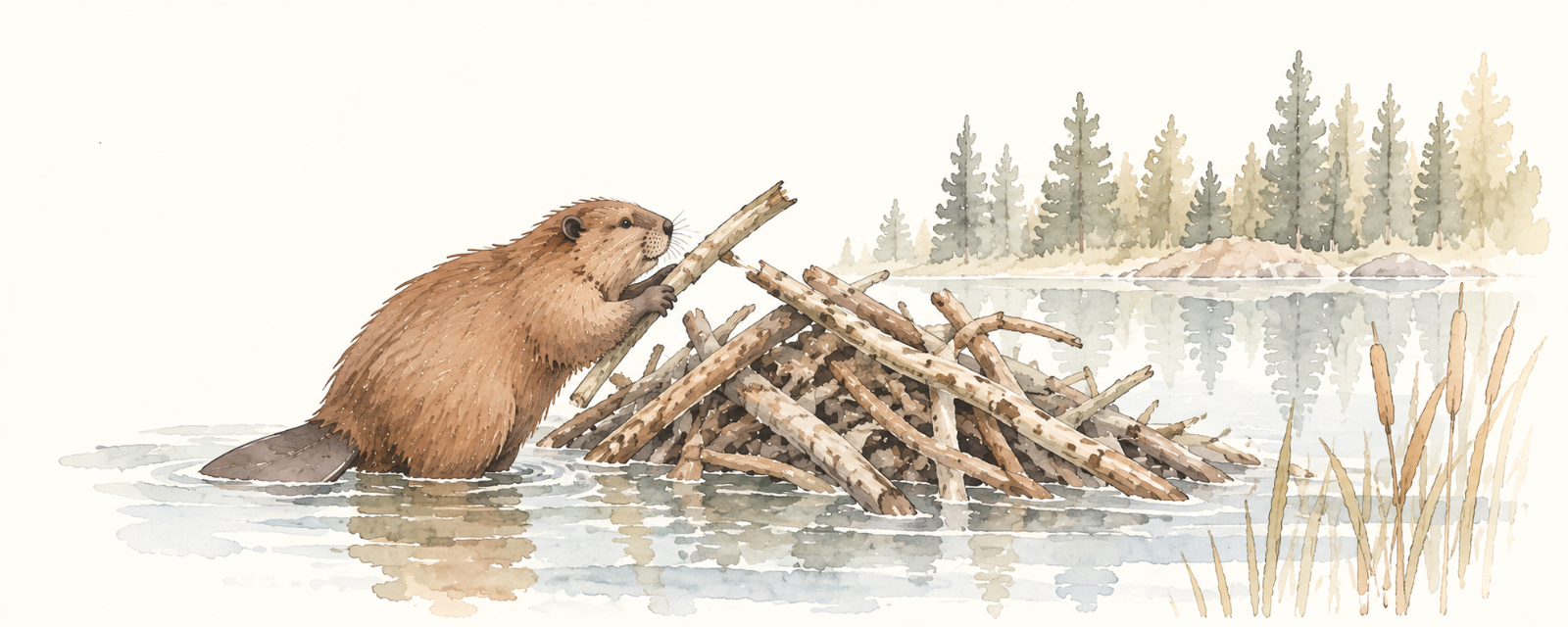
A beaver does not find leaks in its dam by looking. Decades ago, a Swedish biologist named Lars Wilsson played a recording of running water through a loudspeaker, and his beavers piled sticks over the speaker even though no water was escaping anywhere near it. Offered a real leak they could see but not hear, they ignored it and kept burying the sound.
The trickle is the trigger: a sound means a hole, and a hole could drain the pond the beaver needs to survive the winter. In Alberta, a landowner has used the trick in reverse, playing running water through a speaker to invite wild beavers to build exactly where he wanted a dam. Beavers worked with loose parts long before anyone named them.
Sources: CBC News · Mental Floss, on Lars Wilsson’s experiments · Hinterland Who’s Who
How did loose parts start in my class?
I learned about loose parts when it became clear the funding to send my class to Forest School each week would not be renewed. By then, I had been taking classes outside for two years, both to the forest and on the school grounds, and I had seen the positive impact on my students’ achievement and well-being. I knew how deep and engaging the play at Forest School was, and I could not imagine my future students missing it.
I also felt confident enough to try something new. Rusty Keeler and the work at the Hands-on-Nature Anarchy Zone in the Ithaca Children’s Garden inspired me, and our team wondered if we could recreate that kind of play on our own schoolyard.
So we decided to pilot a loose parts adventure playground on our school soccer field. My principal gave me $100 to buy materials, and we gathered the rest from our garages. We even found a set of recycling boxes in the school’s back storage area. We ran one session with our classes, and then another at recess with the whole school, and we were blown away.
What is the teacher supposed to do during loose parts play?
My colleague Madame Joanne and I ran these sessions together for years, and the first thing we had to learn was how to stand back. During the first session, the students were building a family car with wood cookies as the steering wheel and tires. At one point, it looked like students were arguing. But we held back. It turns out, it was part of the play. The tire was flat, and one student was being directed (happily) to go fix it.
For educators new to loose parts, the real work at the start is tolerating not knowing what will happen. The first stretch of a session can look like nothing, or like chaos, and the instinct is to step in and turn it into a lesson. Stand where you can hear the rich conversation and write down who worked with whom and what problem they solved. Take that evidence of learning back inside, and use it to plan the next session.
Each year, I invited teacher candidates to come and observe loose parts in action. Some felt moved to “do something” and ended up entertaining the students. More than a few took over the building or organized a game of tag. They missed what they had come to see: students engaging in free-chosen, intrinsically motivated play.
Are loose parts safe on a schoolyard?
Students get scrapes and bruises during recess. Any duty teacher will know how many times students ask to go inside for ice. Anecdotally, I have found fewer incidents when students are outside using loose parts.
Before each session, we checked the materials and pulled anything split or cracked. Once the materials were out, we gathered the group and reviewed the guidelines the students had helped write: walk, don’t run; drag the planks, two students if it is heavy; if someone has a loose part, it is not your part. The students who moved the heavy pieces learned to judge what they could carry and when to ask for a second pair of hands. The adult visitors were always impressed by how well the students followed the rules.
Where do you get loose parts for free?
You may already have most of them. Check with your chief custodian and principal first. Good places to look include the storage area or recycling bins in your school. I have sent home a short donation letter home asking for crates, old pots, wooden spools, cardboard, fabric, buckets, offcuts, and lengths of pipe. Families and local businesses are usually glad to pass along what would otherwise go to the curb. But I have always reserved the right to send loose parts back. School districts do not want to be on the hook for waste disposal if the parts do not meet the safety standards.
If you want to try one thing first, put out a stack of cardboard boxes and nothing else. Watch what your students do with them.
Loose parts days go better when the class already has quiet routines. My students learned theirs through What Is a Listening Walk?, and the learning activity guide is free: get the free Listening Walk learning activity guide.
If you want the full set, I lay out the routines, the safety notes, and the first challenges to use cold in the Maker / Loose Parts collection, coming this fall.
For where this fits in the bigger picture, see Outdoor Learning on a Schoolyard: The Big Idea.
Questions teachers ask
Are loose parts just for kindergarten?
No. The materials are the same at every age; the students just do different things with them. Older students design working water runs, pulley systems, and structures they can stand inside.
Is this the same as forest school?
No. Loose parts are materials you can lay out as a provocation, even on asphalt; no nature required. Forest school is a much longer commitment, and I have written about it in What Is Forest School?.
What do I say to an administrator or parent who is worried about the sticks?
Have a conversation with them. Review how you plan to set guidelines for use, or, even better, the list of rules your class created. Share your process for checking materials before a session. Most of the worry comes from not knowing what happens out there, so invite them to come and watch one.


Leave a comment