
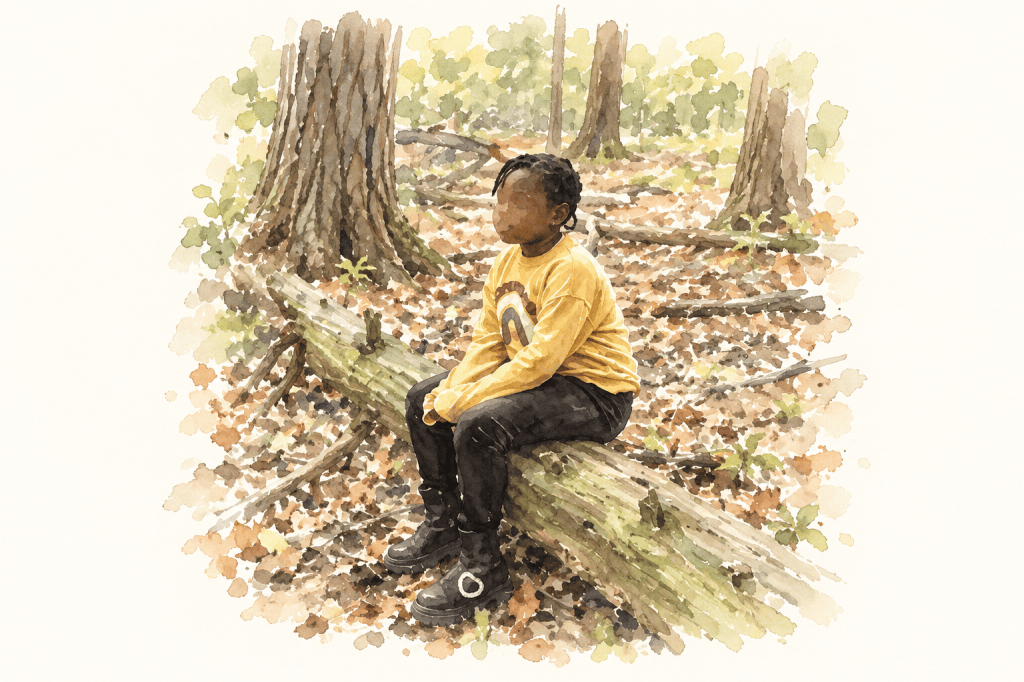
A sit spot is a mindfulness activity you do outside. One of my six-year-old students once defined it this way: “It’s when you sit quiet enough that you hear.” It happens in a spot a student goes back to, sits down in, and stays in long enough to notice what is happening around them.
When we begin our sit spot ritual, I remind students, “During a sit spot, we stay silent, sitting, and still.” I say it because students want guidelines and a bit of direction. While I am not a stickler for silence, I do hope for quiet and calm. But not everyone is built for stillness. Truth is, our sit spots are silent-ish, sitting-ish, and still-ish. If somebody finds two stones and taps them together, I let it go.
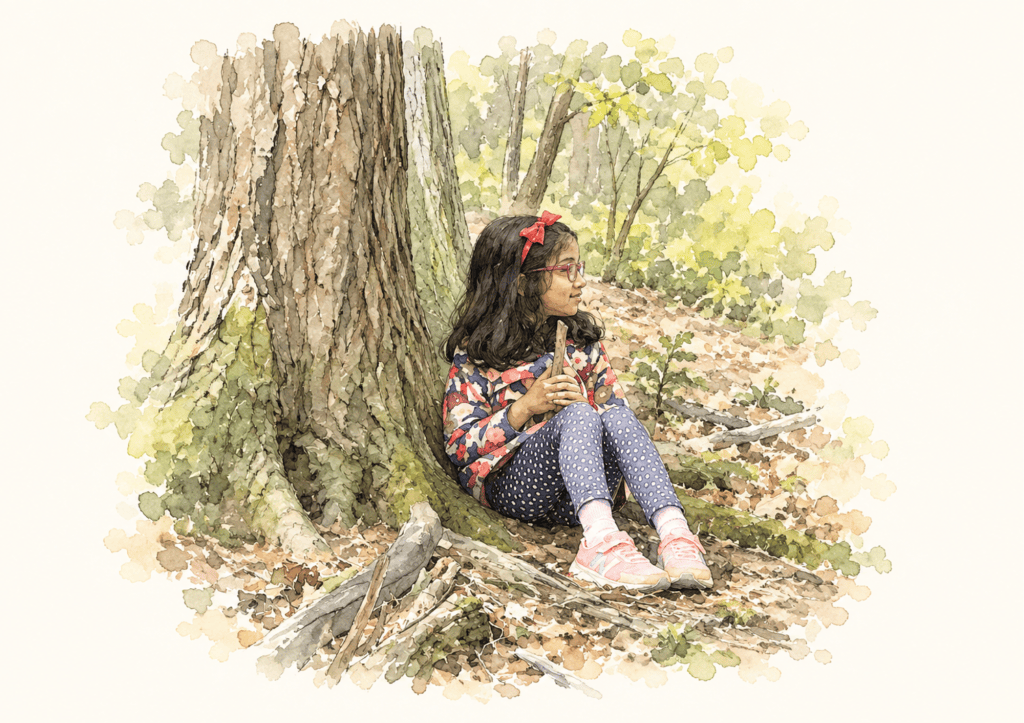
I follow a ritual, and the students take it very seriously: your spot chooses you. You know because the spot “calls” you. (Shout out to Petra!) As one of my students described it: “When you find a spot, and you sit down, you find a magic place, and it’s calling for you. But if somebody gets there before you, then it’s not your spot.”
I sit too, and I try to be present. I used to take photos and videos to document our learning, and the moment I pulled out my phone or the iPad, some students lost their focus. Sometimes it would be me.
Where does the sit spot idea come from?
The first time a class does this, I tell them a story. It is inspired by Coyote’s Guide to Connecting with Nature, Jon Young’s book, which shaped how I teach outside. In it, a person goes back to the same spot over and over, waiting for wisdom to come. They are silent, sitting, and still. Nothing happens. They go back anyway. And then one day it comes.
In all the years I have told that story, no student has ever asked me what wisdom is. It is one of those things: if you know, you know. They go with it, and if they are patient enough, wisdom will come.
How long should a sit spot be?
I do not start with a full fifteen-minute sit spot. I start with three or four minutes and add time as the class gets more practice. I would rather build time stamina than sitting-silent-and-still stamina, because what matters most to me is giving students that time to reflect.
What about students who find quiet hard?
Quiet does not feel the same to every student. This is a part of my practice that came later. For a student from a chaotic home, or one carrying something heavy, a few minutes alone with nothing happening can be uncomfortable. So I set them up for success.
One year we had a Sit Spot Club. A small group of students practised with me for a minute here and a minute there, so that when the whole class went out, they already knew what was expected.
As the class spreads out to choose, I might walk beside a student I am thinking about and say quietly, Oh, this is your spot; I can hear it calling you. The spot I am pointing at happens to be near mine.
Field Note
The bird that hunts by ear
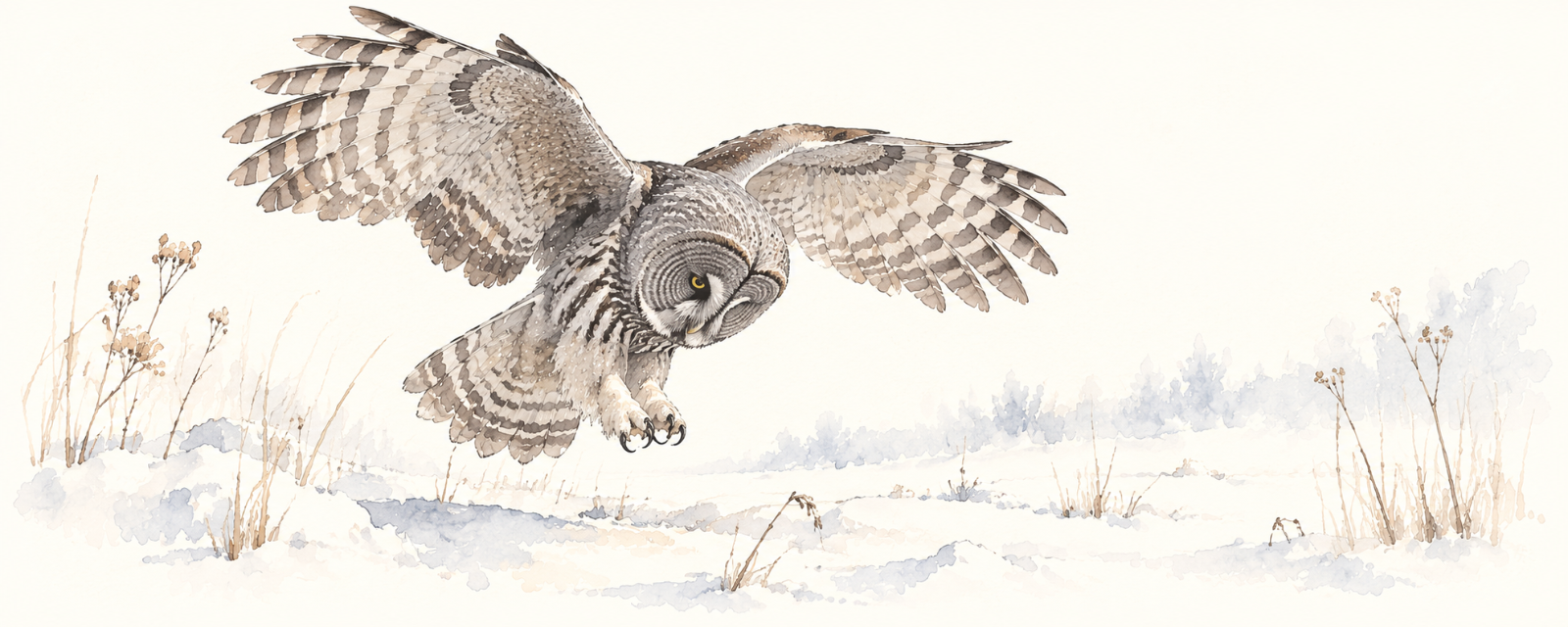
An owl flies in near silence. The edges of its flight feathers are fringed, and the surfaces are downy, which muffles the sound of the air, and its ear openings sit at different heights on either side of its head. The round face is a dish that gathers sound toward it, which is how an owl can place a vole it cannot see.
A great grey owl, a bird of the Canadian boreal forest, will drop from a glide straight through the snow to reach that vole. One was recorded breaking through a crust hard enough to hold up a grown adult. That is the skill a sit spot practises in a small way: going still enough to hear what is actually there.
Sources: Nature Canada, “The Mighty Great Gray Owl” · Nature Canada, “And just ‘who’ is this?”
What happens when a sit spot goes wrong?
When a student is not engaging, I have learned not to deal with it right there unless it is affecting someone else. I once got up in the middle of a sit spot to speak to a student, and it ended everyone’s sit spot. If I look up and the class is very restless, when the molecules are moving, I stand up and howl. The group comes back and forms a circle. I would rather end a little early than after things have fallen apart. I sort out any issues afterward, and usually not as a correction.
Sometimes, I share something of my own instead: why I love sit spots, that I have a busy life and three children, and this is my moment to stop and just be. Students have busy lives too. They understand how important sit spots can be.
If a student keeps struggling with the quiet, I get curious. I have done sit spots with so many different groups, at every level of ability and enthusiasm, and it works, so when one student cannot settle, I ask myself whether there is a story underneath. Does this student need a spot closer to me next time, a shorter sit, or more support before we go out? Either way, I stay close, ready to offer support if needed.
So did anyone find wisdom?
Here is what some of my Grade One students had to say:
- My favourite place to sit is a tree in our schoolyard.
- I use my senses to hear stuff, smell stuff and touch stuff.
- If you sit next to the sun, it gets warmer, but if you sit next to the shade, it gets colder.
- If you’re really frustrated or scared, you can have a sit spot.
- You feel your body, and you feel confident.
- In sit spots, I feel happy, still, and I’m very calm.
- I feel happy because I had time to sit.
And then there is this exchange with a girl I used to teach, which I think about often.
If you’re really quiet, you’ll get wisdom to come to you.
I asked what that means when wisdom comes to you.
It means that you get kind of centred.
I asked how you get centred.
By being really quiet and still.
How do you run a first sit spot?
- Take the class out and gather them in a circle.
- Tell them a story, in your own words, about someone who went back to the same spot to notice what was around them.
- Share the parameters: silent, sitting, and still.
- Invite each student to walk quietly to a spot, and remind them that their spot chooses them.
- Sit down in your own spot and stay there for three or four minutes the first time.
- Call the group back.
Afterward, ask what they noticed and write down what they say. That is the evidence you take back inside.
What Is a Listening Walk? is the companion routine, and that learning activity guide is free: get the free Listening Walk learning activity guide. What Do You Need to Take a Class Outside? covers the gear and logistics. For the broader case for teaching on your own yard, read Outdoor Learning on a Schoolyard: The Big Idea. The full sit spot sequence is in the Sit Spots learning activity guide (it is in the Sound & Quiet Collection): the Coyote story as I tell it, the language for setting it up, seasonal variations, and what to do when it goes sideways.
Questions teachers ask
Does a sit spot work in winter?
Yes. Keep it short, and let them stand instead of sit if that helps, or bring foam cushions to use as insulated sit-upons. Students do some of their best noticing in winter.
Do students have to write anything down?
No. Some students want to record what they noticed, and I make journals and pencils available, but plenty are content to see, think, and wonder, then share their answers in the circle afterward. I take anecdotal notes to record their learning.
Can you do a sit spot on a mostly asphalt yard?
Yes. A spot is anywhere a student can sit and be a little apart from the others: the base of one tree, a spot along the fence, the edge of the field. One of my students’ favourite spots was sitting on the ground with his back to the exterior brick wall, warmed by the sun.
How often should a class do sit spots?
I prefer one sit spot for each extended period spent outside (two- to four-hour blocks). When I taught outdoor learning as a prep coverage teacher, I included one sit spot a week in forty-minute blocks.
What if the whole class is restless that day?
End it. Call them back, sit in a circle, and ask what they noticed anyway. A short sit spot that ends well is worth more than a long one that falls apart, and you can try the next day again.


Leave a comment