
Emergent curriculum is an approach in which teachers plan the next learning experience based on what students are curious about right now. The required curriculum does not shrink. You still teach and assess every expectation; what changes is the order you meet them in and where the lessons start, which come from the students instead of from a unit plan written in advance.
Before I taught in public schools, I taught Montessori, where “follow the child” was our motto. Careful observation meant that when a sensitive period, an innate urge to learn specific concepts, like language, order, or an interest in colours, revealed itself, I would introduce them to a specific lesson, like the colour tablets. Those materials sat ready and in order on the shelf. When a student was introduced to a concept, for instance, related to sensory perception during the sensitive period (from 0-5 years), they could learn to use materials to explore touch, sound, taste, smell, or colour and repeat tasks easily without getting bored or needing rewards. The child decides when; the curriculum is already laid out.
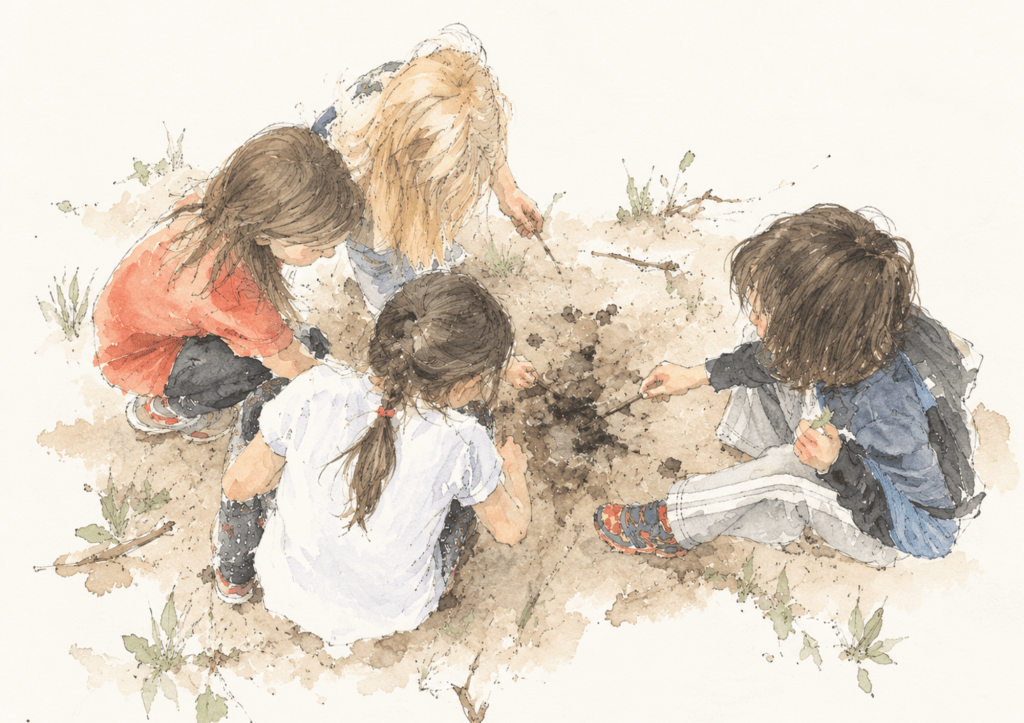
In emergent curriculum, the educator’s job runs in reverse: instead of matching the child’s readiness to a specific lesson, you find the required curriculum inside whatever the students cannot stop looking at. Through outdoor learning and “thinking outside”, I built my confidence in facilitating emergent curriculum and letting students’ interests shape the content and timing of learning.
One afternoon, a slug turned up during our outdoor math lesson, as slugs do. And before I knew it, my students were no longer interested in making tens with leaves. I had the choice every teacher knows: get the class back to the day’s lesson, or go with the flow. I chose the latter, and we spent the rest of the afternoon observing slugs and learning about their needs and characteristics. We eventually got back to math, but the living things inquiry was too good to pass up.
Field Note
The slug has thousands of teeth
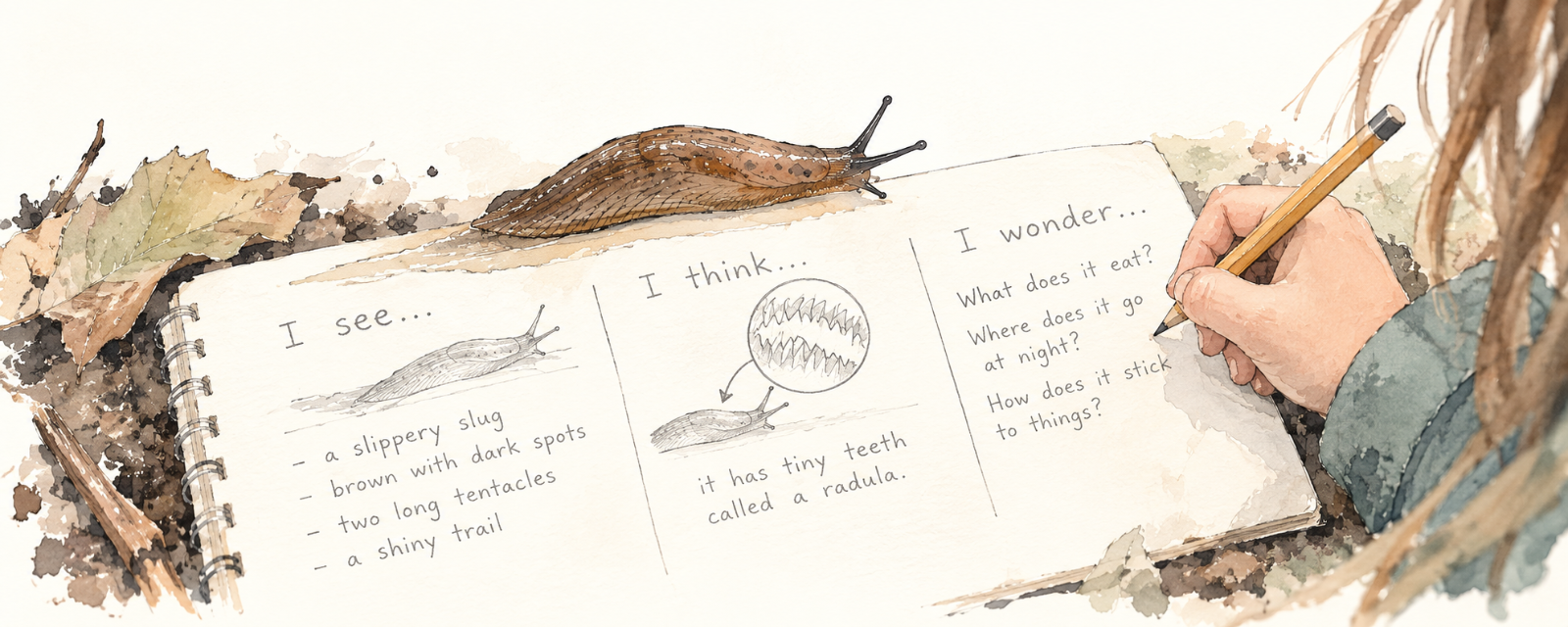
A slug’s mouth has a radula, a ribbon of tissue covered in rows of tiny teeth. A slug carries thousands of them and uses the whole ribbon like a file to rasp its food. The teeth wear down at the front, and new ones grow in at the rear.
A slug also breathes through a hole in its side, just behind its head, and it travels on slime it makes itself. That slime does several jobs at once: it smooths the way, keeps the slug’s body from drying out, helps protect it from predators, and grips well enough that a slug can climb a vertical surface.
Sources: Hinterland Who’s Who · Britannica, “Radula”
Does emergent curriculum mean teaching without a plan?
Teachers hear “emergent” and picture the curriculum vanishing while they improvise all day. That is not what happens. You still cover every expectation you always covered, and you track them deliberately. What you give up is the assumption that you know, on Monday morning, where the students’ interests will lead them that week.
Isn’t this just a Kindergarten thing?
Today’s kindergarten classrooms embody the emergent curriculum. Educators observe students at play and build learning from what they see every day. While Ontario’s new Kindergarten Curriculum, in effect from September 2026, includes more direct instruction than the one it replaces, play-based learning remains central.
Teachers only start thinking of the emergent curriculum as something radical at the primary level, when the timetable gets more structured. But six- and seven-year-olds are still curious, and they still play to learn. While the emergent curriculum may be a starting point for kindergarten educators, I place it in the Digging Deeper section of the Thinking Outside website because primary teachers need more nerve (and support) to try it.
How do you keep track of the curriculum while following students?
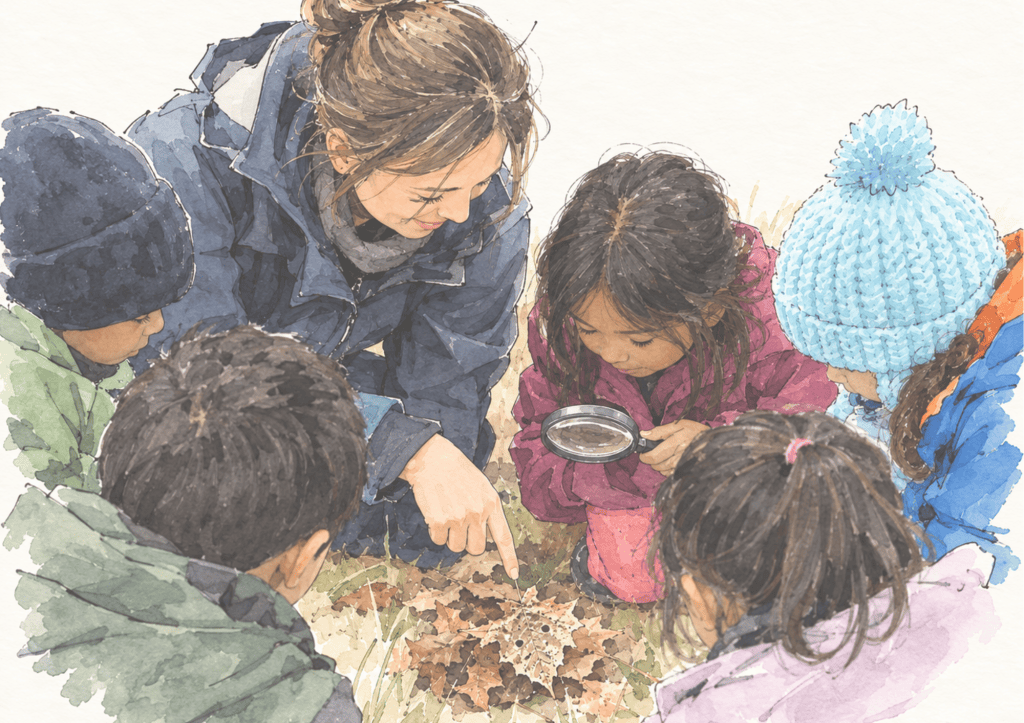
I do one thing that makes following your students emotionally safe from a professional standpoint. Before an outdoor session, I know which expectations I am responsible for that week. I bring a clipboard with me and gather evidence as soon as students demonstrate their knowledge and understanding of that expectation. When a student gets caught up in something, I hold it up against those expectations. I ask myself, “Where is the Math, the Science, the Social Studies, or the Language in their play?” and whether there is something I can name, assess, and keep as evidence of their learning. Most days I find and record more than enough data to properly assess student achievement.
Why does this work better outdoors?
You need open-ended materials for this, and outside there is an endless supply. Indoors, the interesting things are the ones you set out that morning. Come back to the yard the next day, and there is a new supply of loose parts and learning materials: fresh tracks, overnight melt, a downed branch, a woodpecker working a tree.
For more information, check out this post: What Is Environmental Inquiry?.
Why is this a Digging Deeper move?
To run a fully emergent program, you need the skills to:
- Observe students at play and recognize which curriculum expectations they are meeting.
- Document learning that shows up as conversation and action, because there is often no product to collect afterward. Think running anecdotal notes or photos.
- Stay steady when you feel the pressure to follow a day plan and the timetable, or when report card writing season has you second-guessing whether their play counts as learning. Spoiler alert: it does. The learning is in the richness of the play.
Kindergarten colleagues practise all three, every day. The rest of us in elementary schools do not have as many opportunities. A teacher who jumps into a fully emergent program without that practice might give up on the approach before these skills have a chance to build.
You do not have to change your whole program to try this. Pick one strand of one subject and teach it this way for one term. Science is the natural choice, because the yard already supplies the material: the needs of living things, seasonal change, soils, etc. For that one strand, build the lessons from the questions your students bring back from your outdoor sessions. Keep teaching everything else exactly as you do now. One strand for one term is enough practice to know whether you want to go further.
This is close to the gradual release we already use indoors: I do, we do, you do. With emergent curriculum, you are letting your students take the You Do, while you stay accountable for the teaching and the learning. For the deeper version of this, once your routines are solid, see Digging Deeper: Student-Led Outdoor Learning.
Do you still have to report on it?
Emergent curriculum is not a licence to skip the reporting. You assess on the same expectations you would if you were teaching inside. But the data comes in different shapes and sizes.
Gathering evidence of student learning requires consistency. I like checklists, photos, etc. I also used to have an active Twitter feed (before Twitter made me sad) that served as my exit ticket for the day. For how assessment works while you are outside, see Going Further: Teaching the Curriculum Outdoors.
Where do you start?
The next time your students get caught up in something outside, give it fifteen minutes to emerge into learning and keep the learning expectations in mind. Afterward, name what was learned and show evidence of it in whatever form works for you.
The free Listening Walk is one way to give students something to notice: get the free Listening Walk learning activity guide. The lesson plan also includes an assessment tool for the educators to record student thinking.
To learn more about play and the Elementary Curriculum, see Play-Based Learning Outdoors: What It Looks Like After Kindergarten.
Questions teachers ask
Do you still cover the curriculum?
Yes. I keep a list of the expectations I want my students to explore that term and tick them off as I see them met, with the date and a note about what I saw. Anything still untouched near the end of the term, I teach directly.
How do you plan for emergent curriculum?
Know your expectations cold. To set the stage, start with a read-aloud, lay out a few interesting objects (magnifying glass, field guide, a feather, a rock, etc.) or ask questions to spark student interests.
How do you assess emergent learning?
You capture it while it happens: observations, conversations, photos, and the things students make. Journal entries are great, and completing the story-of-the-day writing activity is too. None of these differ from the evidence you already collect indoors.


Leave a comment