
Every August I get the same questions from teachers who are thinking about trying outdoor learning this year. Where do I start? How can I do outdoor learning on a schoolyard?
Getting your students thinking outside really is simple and straightforward. You do not need special training, a pristine forest, or a huge budget. You need a plan, a routine, and one 20-minute outing to start. All of the setup and learning activities I share on this site work with regular classes, on ordinary schoolyards, following a bell schedule, and in French. Here are the FAQs and my answers, based on years of doing this.
Do I need special training or certification to teach outside?
No. Any certified teacher is qualified to take a class outside during the school day. Forest School training and outdoor-education courses exist and are worth doing, but they are enrichment, not a licence, and no Ministry of Education requires them for learning on the schoolyard. What you need is know-how, and a bit of confidence in what your students are already curious about. For more details, check out Outdoor Learning on a Schoolyard: The Big Idea.
Do I need a forest near my school?
No. Some of the anecdotes I share come from experiences in a variety of outdoor settings, but every learning activity guide was tested and works on any school grounds, whether you have pavement or an open field.
A regular schoolyard is not an empty one. Listen along the edge of the pavement in early fall, and you will hear crickets, les grillons in a French Immersion class.
Field Note
The cricket that freezes solid and lives
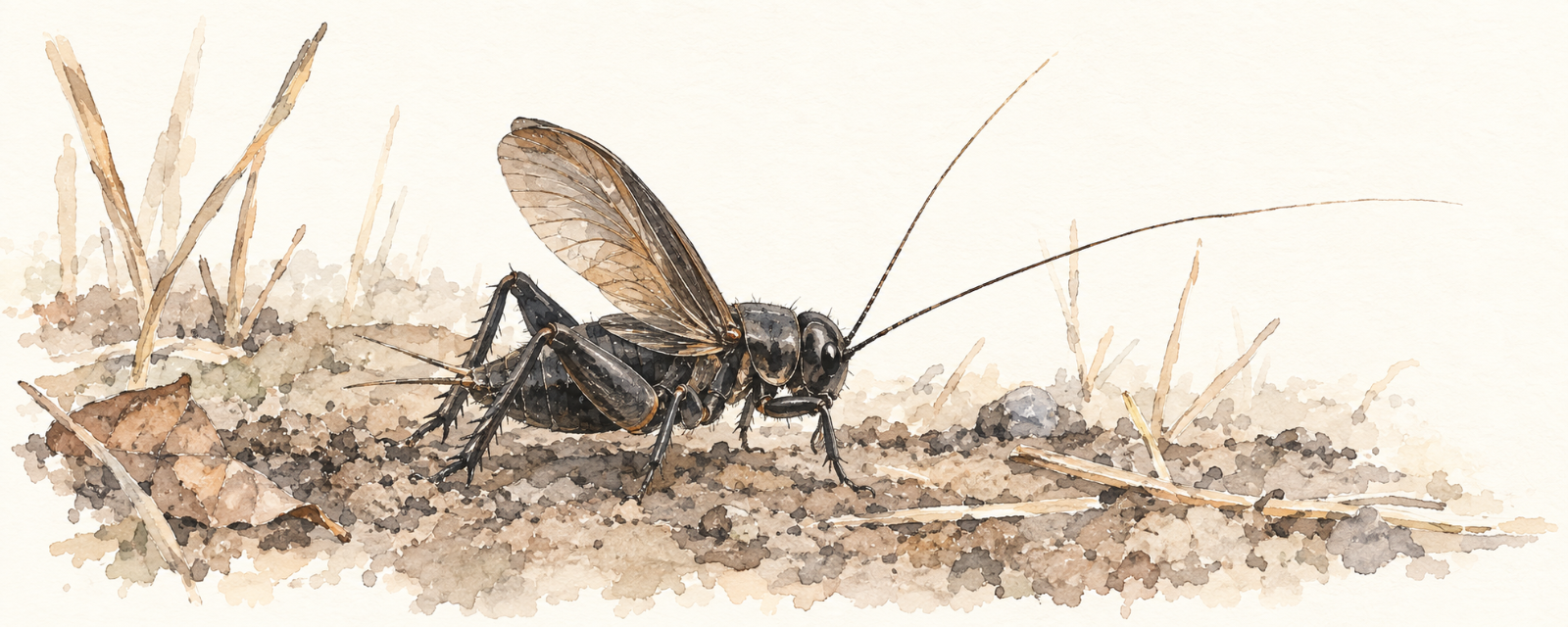
The crickets you hear along the pavement in September are fall field crickets, and none of them will be with us after the first hard frost. Before that happens, the female will push her eggs down into the soil with a spear-shaped tube at the end of her body. And the new generation will roam the following spring.
A second black cricket on the same ground does the opposite. The spring field cricket spends the winter as a half-grown juvenile, and a fall of steadily dropping temperatures turns its body freeze-tolerant. Researchers at Western University in London, Ontario, ran experiments in which they placed black crickets in eight below zero for a week, with ice inside them, and they survived.
Sources: Toxopeus et al., “Laboratory acclimation to autumn-like conditions induces freeze tolerance in the spring field cricket,” Journal of Insect Physiology 113 (2019) · “Cricket (Insect),” The Canadian Encyclopedia
A schoolyard you visit each week is more than enough to get started. The students come to know all of its nooks and crannies. And once they know it, they start to notice things.
Does outdoor learning cover the curriculum, or is it extra?
It covers it, or should I say, it uncovers it. Observation, sorting, measuring, descriptive writing, mapping, and oral language are part of the curriculum in every jurisdiction I know of. Many ideas in this blog are comparable to lessons you already teach, but taught in a different place. Nothing extra gets added to your day. More on this is in Going Further: Teaching the Curriculum Outdoors.
What about weather?
I go outside rain or shine (or twenty below), but I also dress for it. Send a note home in September about outdoor-ready clothing, and you’ll head off most complaints. In cold, wet November and April, a student who comes to school in a hoodie feels it fast, so layers matter more than the forecast does.
What about very hot or very cold days?
Check your school board’s weather guidelines. They often have policies based on temperature or air quality. We had to stay indoors a couple of years ago when forest fire smoke reached our city. When I stay in, and why: cold on its own is almost never the reason. It’s in What Do You Need to Take a Class Outside?
How do I keep thirty students safe and accounted for?
The same way you do inside. The boundary, the signal, the headcounts, and information I leave at the office are all in What Do You Need to Take a Class Outside?
What will my principal say?
Almost always yes, when the ask is specific. Bring the where, the when, the expectations you are covering, and how students stay supervised. They’re more likely to turn down vague requests that sound like unstructured play.
What about the students who struggle with structure?
Some students push hard against the four walls of the classroom, a signal they need a different setup. Those are the students I take outside. I have observed that a student who struggles to sit still all morning becomes focused and engaged outside. Start with structure, keep the first outings short, and hand over responsibility little by little until you trust that the students are eager to learn.
How much money do I need?
Little to none. You can find many items around the school or in your classroom. Add in a few donations, and you are off to the races. What an outdoor learning setup actually costs, and where mine came from, is in What Do You Need to Take a Class Outside?
What if I teach French Immersion or have multilingual learners?
Then the yard is one of the best language tools you have. When students know a place, the new vocabulary sticks. Oral language comes more easily too, because they actually want to tell you what they saw. My own students went from fleur to trèfle and bouton d’or over one school year, and I never drilled those words. They knew the plants. My story is in the About section of this site, and the risk-taking half of it is in Why My French Immersion Students Wouldn’t Take Risks.
Where do I actually start?
Start with one 20-minute outing built on a single routine, then add a learning activity once the routine holds. The Listening Walk is a good first step into thinking outside. The free Listening Walk learning activity guide, with its student journal pages, is ready to print. Get the free Listening Walk learning activity guide.
If you want to know what it is before you print it, read What Is a Listening Walk? And if the whole idea of going out for the first time is what worries you, that is Taking Your Class Outside for the First Time.
A few more questions that come up
Do I need special permission to use the schoolyard?
Usually no more than you already have. Check with your administrator first. Tell the office you are going to the schoolyard, leave your plan, and follow your school’s normal procedure for leaving the building. A neighbourhood walk off school property is the one that needs the usual field-trip form. Many school boards allow blanket field trip forms for adjacent green spaces. Check your board’s policies and procedures.
How often should we go out?
Once a week is plenty to start. Pick a weekly slot for the class that works for you and your schedule. An ambitious plan you drop by October is no use to anyone.
Isn’t this just for the younger grades?
No. I have taught outside from Kindergarten through the junior grades. The routines stay much the same. What changes with older students are the curriculum links.
What about a student who uses a wheelchair or has other access needs?
The schoolyard works for a wider range of needs than a desk does. Plan the route for the least mobile student in your class, choose surfaces everyone can use, and build the outing so the whole class does the same activity together.



Leave a comment